
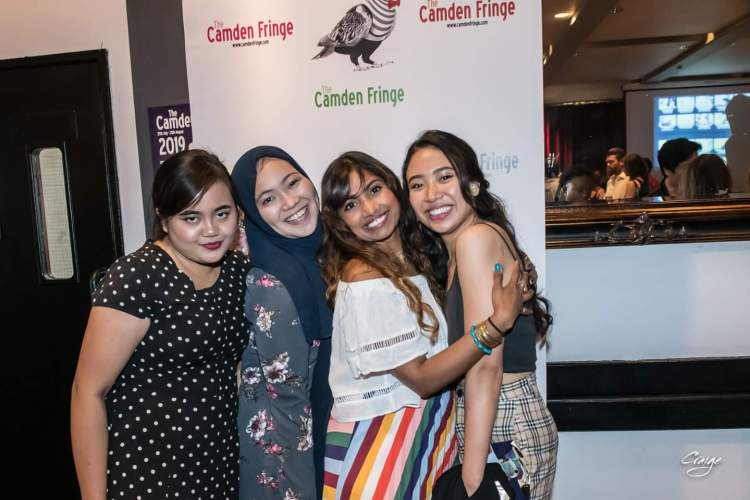
FK CO-LAB is a London-based Singapore company. They are an international female-led team, curious about how international voices can bring fresh perspectives. Currently, they are working on The Cardboard Kitchen Project, a one-woman play uses traditional family cooking to examine cultural history and cultural differences. I had the chance to talk to them about hunting out recipes, and working as an international team in London and the challenges of Fringe stages. They also told me what the dramaturg actually does and shared the journey of becoming one. They are performing at Camden Fringe on the 19th and 20th of August and I so wish I could be there.
Tell me a bit about the show – what is it about and what kind of audience is it for?
It is a show about this character Jennie who moves to London from Singapore and receives a cardboard kitchen from a mystery sender. She thinks she knows who it is from, so when she builds it she discovers some things about herself and where she is and where she came from… that is, until she uncovers something she has been trying to get away from. It’s quite an accessible piece about change, space, and memory that can resonate with everyone. We’re bringing this to the Camden Fringe in London so we feel it would especially resonate with audiences who have moved to London from somewhere else, and have had to leave something behind, be it our families or our cultures.
What inspired you to create it? I know, I know this is a cheesy question! But with you guys being a diverse group of female theatre-makers creating a show about exploring cultural history through family history, it seems very important!
It’s very interesting, because in a kitchen – any kitchen – there are usually a couple of basic ingredients, like garlic, onions, pepper, and all that. And no matter what culture we are from, we all throw them into the pot, but then something happens there that the end product is always something culturally specific and often something that’s within the family. We thought it was such an interesting metaphor to get us thinking about change and memories, and we thought that having a diverse all-female team would help bring in voices that we wouldn’t necessarily hear talk about space and change.
I am really interested in the role of recipes in the show. Can you tell me a bit more about it? Patchwork Ensemble, an Indian theatre group, did a series of workshops on creating theatre pieces around family recipes. It seems like such a fascinating idea and I really want to know how you work with it in the play, how it’s implemented into the show and how it works to develop the narrative!
We’ve gone through quite a journey exploring the role of recipes in the show. We looked at everything from how it’s a tradition that is passed down and how it’s essentially an instructional manual for culture. We previously did an installation in Singapore and in London collecting recipes and stories around the kitchen to look at how different cultures from different ends of the world look at these things, and we’ve used these ideas and the differences in these cultures to develop our character Jennie’s journey as she moves from one city to another and also how we can begin to look at what a kitchen made of cardboard could mean.
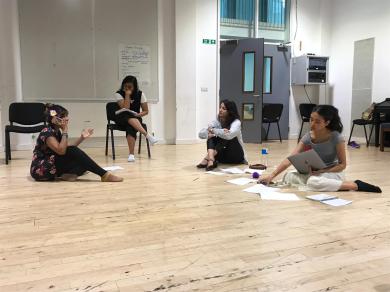
Aida, tell me a bit about your role. It’s not often that I see a dramaturg credit on a Fringe show! What do you do? How is your role distinct from a director and what does having a dramaturg add to the productions?
The role of a dramaturg changes massively from production to production. It depends on the director, the playwright, and the collaborative relationship we build together.
But, to answer your question of what a dramaturg does, I’ve always envisioned it as a tour guide. All the creatives in the team (the playwright, the director, the designer, the actors…) are building this world of the play, where time and space have their own rules. There is actually a beautiful essay by Elinor Fuchs in which she conceptualizes plays as little planets, so that is where I got this image from. So, the dramaturg is a curious inhabitant of this world that is eager to know how all of it is working and is connected.
As new elements appear in the world, the dramaturg meets them and remembers them, putting them into context in the structure of the planet. So, when the director, the playwright, or even the designers get lost in this new world they are creating, the dramaturg is there to help them find their way. The only caveat is, dramaturgs don’t give instructions on what to do; ideally, they communicate in questions that arise from the curiosity of being witness to a creative process.
Dramaturgs don’t directly communicate with the actors (unless they are putting together an actors’ pack with research about the play) and they do not juggle the different elements in the production in the same way a director does. They are actually a step removed from that, so that the director, who is deep into the creative process leading the actors, can have a set of supportive, informed eyes to refer to. I am of course biased, but I think a good dramaturg is a very powerful tool for a director who knows how to work with them.
What attracted you to the role of a dramaturg and how did you get into it? Did you come from another production role or did you start straight away as a dramaturg?
I have always been attracted to the theatre, but I had never actually considered it as a profession until my last year of undergraduate studies at Harvard University. I took this class in the Drama Department called Production Dramaturgy, not knowing what it really meant. I soon understood I had found what I was looking for. I then completed an MFA in Dramaturgy in the American Repertory Theatre/ Moscow Art Theatre Institute for Advanced Theatre Training.
I have always been very nerdy, very curious but never too focused on a subject. I wanted to know about everything. Production Dramaturgy was a way to lean fully on that: you get to research all types of topics for different projects, work with all types of people… and all in the theatre world. It gave me access to the process of great artists, and to great existential questions such as ‘what is good theatre?’ or ‘what is to be present?’
What are the particular challenges and exciting bits of working on a Fringe show as a dramaturg?
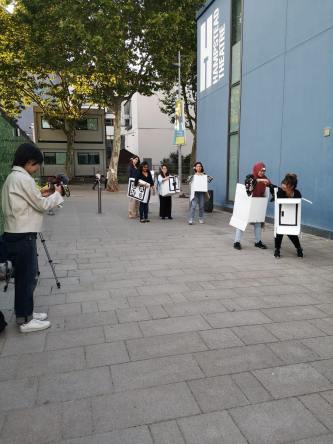
I’m loving working with FKColab and their team. The dynamics are very different from those of bigger shows: it feels like a family more than any other show. Faezah, our director, has made sure that everyone has a voice during each rehearsal in a way that you don’t often see in the traditional theatre model. As a dramaturg, that agency is very refreshing.
The particular challenges that come in Fringe productions can be seen as opportunities. Timeframes are short and we don’t have the luxury of a full-time rehearsal schedule. And yet, the show has changed radically from when we started rehearsals because everyone is putting all their energies to make it happen. As a dramaturg it is beautiful to be such an integral part of seeing a show grow from conception to stage.
Last but not least, I am the only team member who is not from Singapore. I am constantly learning from the rest of the team. Personally, the conversations we have had about culture, home, family, memory, and identity have been the most valuable part of the process. And it all reflects on the piece, so I hope it inspires audiences to have these conversations too.
Raycher, in terms of lights and other tech – do you adjust it depending on the venue? or are there design elements that are crucial and have to be in the show no matter the venue? If so, how do you work with limited resources of small scale venues?
I absolutely think it’s very important to make a rig that works for the space. Every venue has that little something about them, whether it be a quirky architecture or interesting rigging position. I think it is the lighting designer’s job to bring that uniqueness of a venue to life through a tailored rig for the venue. The smaller scale the venues are the more it makes you think how to creatively use the resources you have to cover essentials as well as to make it interesting. Practicals are always a good way to individualise the piece. I think it is a lot about compromise and how you make those compromises work in your favour.
How do you make sure that set and tech create the unique world of the play, convey the atmosphere and ground the audience in it, even with limited resources?
I think I always try my best to have loads of conversations with directors, playwrights and sound designers about what it is we are trying to convey as a company. Once you find yourself on the same page as everyone else it is easier to focus your attention on what is key and what are things that are nice to have
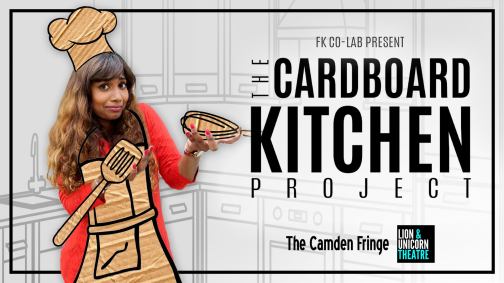
The Carbdoard Kitchen Project is on at Camden Fringe Monday 19 August 2019 & Tuesday 20 August 2019, 8.30pm
 Theatre Machine