
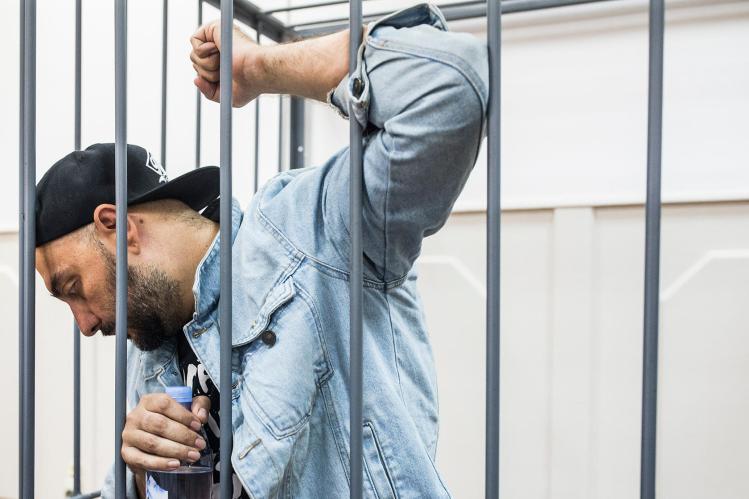
The photo above is Kiril Serebrennikov in court today, taken by Evgeny Feldman for Meduza – an online magazine which covered the events of today in great detail.
The world is in enough unrest at the moment for this subject to remain our very personal dirty laundry, especially seeing as it’s so specific. However, I think there is a lot to be taken from this example about our expectations for freedom of speech and what sort of decisions you have to make when that freedom is no longer a given.
In 2015, Timofey Kulyabin production of Tannhauser caused an outrage amongst Russian theatre traditionalists and Orthodox activists (It has erotic scenes and featured an image of Christ between woman’s legs). Subsequently, the production was banned and the director of a theatre that offered a stage for it was fired.
In the same year, Theatre.Doc, a fearless independent theatre company, which stages plays about subjects such as the LGBTQ community in Russia, Ukraine and immigrants in Moscow, got regularly raided by the police and evicted from the buildings the theatre occupied three times. Today, they continue operating without government funding and making plays about things that nobody else would say. However, if you go there you must remember that it’s very much not uncommon to have the performance stopped by the anti-extremism division, because there might be a bomb in the building, they then march the entire audience outside and do a thorough ID check.
May 2017. Kiril Serebrinnikov, the director of Gogol Centre, which aims to make experimental, contemporary theatre, was charged with embezzling 68m rubles. Alongside him a number of his colleagues were arrested. Serebrinnikov’s house was searched for evidence, as was his theatre. For a few weeks the case was constantly on the news, then everything went relatively quiet for a while. The investigation continued, and as it did a few very bizarre things happen.
It was suddenly claimed that a 2012 production of “Midsummer Night’s Dream” which he directed never happened. And it definitely did happen. And as you can imagine it’s not easy to erase a show out of existence when there are reviews, recordings, and records of participation in festivals.
June 2017. Serebrennikov’s production of a ballet about Rudolph Nureyev, a 20th century ballet dancer, who was openly homosexual, was cancelled. The show is cancelled so close to being premiered they have to take down the posters for it, which were already up. Bolshoi Theatre issues a statement saying the ballet was not ready to be performed.
Yesterday, August 23d, Serebrennikov was arrested in St. Petersburg, his documents confiscated. It was reported that he spent 9 hours in a van while being transported from St. Petersburg to Moscow. Today it was decided during a court hearing that he will be under house arrest until the 9th of October, when the final decision in the case about embezzlement is made. Need I say that this entire case is fear mongering which has nothing to do with real or made-up crimes?
Theatre is generally considered to be a dead art form in Russia. You would maybe suffer through a four hour performance of Swan Lake to show your child what a stage looks like or demonstrate all the grandeur of old costumes and decorations to friends visiting from another city. The Russian audience also tends to resist new forms of theatre as if their life depended on it. Yet, it seems in the eyes of the government theatre has grown to be more and more of an inconvenience. Over the past few years, a kind of powerful resistance between the brand of theatre, which the Ministry of Culture offers and funds, and an independent theatre, which is not scared to approach taboo subjects and new methods of staging. There is a sort of hope for the future, not only in that new brand of theatre, but also in the fact that today there were 200 people in front of the court, protesting Serebrenikov’s arrest, just like there were protests against banning Tannhauser. People came together to support Gogol Centre, just like they did helping Theatre. Doc to rebuild their space. Those are all small gestures in the grand scheme of things, but they are something.
This post is a list of facts that I’ve collected over a few years, all of which are of course very superficial, as I am far removed from the Russian theatre scene. There must be things, facts, points that I am missing. Yet, it paints a bleak picture. It demonstrates an atmosphere, which is strange to even write about when outside my window Fringe, with its 1500 so performances of all kinds each day, is taking place. It also makes me consider the luxury that unrestrained free expression is. Would I dare to make plays, to watch plays if my freedom depended on it, if I had to choose between silence and the big, scary unknown? I don’t think I can answer that. And I really, really hope I never have to.
 Theatre Machine