

There are so many things to say and ask about “Tissue” that ideally I would like to have spent a week or so chatting to the director Rachel Hobley and assistant director Grace MacDougall, but that won’t make for a very good blog post, so I had to narrow the discussion down a bit. I picked three things I wanted to talk about – human interaction, working with an unusual performance space, and emotional involvement.
From my personal experience, when you start working with an emotionally challenging issue, quite quickly it becomes something close to trivial. That is to say, you still understand the importance of it, but it becomes easier to talk about, easier to joke about – not necessarily bad things, you would say – but eventually they make the issue itself superficial and small for you. The actors concentrate on saying their lines and following the blocking, there is simply no time to be emotional about the script. With “Tissue” it didn’t feel like that was the case at all. I got the sense that every one of the actors was extremely emotionally involved in the play. As in, they weren’t just acting it, they really felt that way. That’s something I find rare and very much cherish in theatrical performances, so it was the first thing I wanted to talk about with Rachel and Grace, asking them how they managed to achieve that.
Rachel: The way in which Louise Page writes brings out a lot of the dark humor in it. We tried to make rehearsals as relaxed as possible. It was actually the more difficult scenes that we laughed through, and that just brings out the humanity in it. There was this one line, this one line in the scene with the boss where she says “my boss offers be a biscuit” and that was it. And we were just like laughing, cackling with laughter through the whole rehearsal. And I think that we found working through it, finding the humanity in it whether it was the laughter, whether it was the depth, the absolute pits of emotion that you can get into. Working through it and constantly asking “Why?”, trying to answer that through finding bits of information, weather it was blogs, or articles or films – experiences that we weave in, weather it was about breast cancer or not.
Grace: From the beginning everyone was bringing their own little bits of information. We had a Facebook group where we could post different things to inspire us – pictures, articles, Youtube videos. The fact that cancer awareness is growing in the media also helped. Like that poster we had – one in three people diagnosed with breast cancer will recover changed to one in two people – that’s the kind of statistics you think about, even if just for a moment.
Rachel: Doing it the second time, as well… We did it with Coppafeel the first time, so we were very conscious about awareness side of things. So playing up the scene where she straight up explains how to check yourself for cancer became especially important. Whilst this time we knew that we’d have people like Cara, like David Cameron (Clinical Director and the chair of Oncology), like Louise Page and all the other people who we knew had cancer in the audience. It meant that in rehearsals we had that kind of real tangibility to it. It’s such a great responsibility and such a great privilege to be able to put something like that on stage that you are never going to let that go.
So, did knowing that you’ll be performing in front of people who have gone through cancer or work with it shape the way you approached it?
Rachel: It definitely changed the emphasis we put on it. We definitely played up from the very beginning, throughout the rehearsal process and especially before the show the responsibility we have in telling the story. We all know people who went through cancer, we all know what it’s like to be on the outside, but everybody has their own story. And so, even if we were performing in front of a group of people who have never been involved with cancer, who don’t know what it is or what it’s like, from my point of view it’s still such a privilege to be able to teach them, even to teach them about how to check themselves. I think even if we did it 100 times and one person checked themselves and saved their life as a result of it, then I’d happily throw millions of pounds at it and do it over and over again. Also, having done it for Cancer Research UK, it almost felt like the guys who were in the Q&A panel, it felt like it was almost a relief for them to see their story on stage. Talking to Rebecca Scott, the public engagement officer, she was saying that the scientists never get to see their side of the story. It was more the case of being accurate, that’s why I think keeping it so simple was so important.
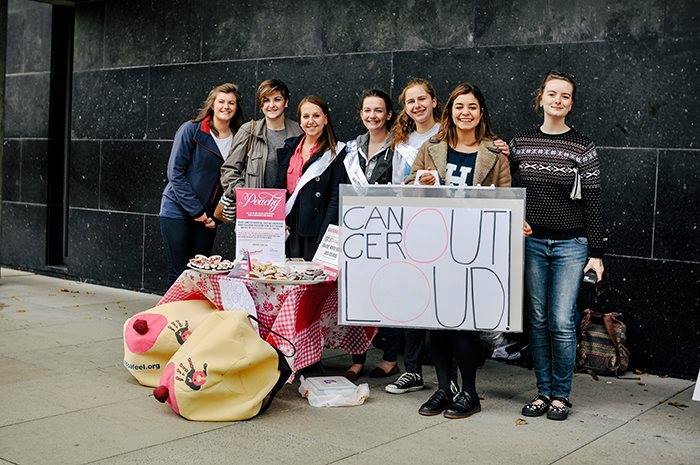
Grace: what I really liked about the play is that it was complex and it was pushing the boundaries about what can be said about cancer. It was pushy because you feel like there is normally just one response you should have towards cancer, which is “it’s awful” but in the play, there are many more complex emotions that are building up around it being explored. Even though the play is set up in the 70’s the issue is still so very relevant today. Many people are still unwilling to talk about cancer; many people are still scared of checking themselves
Rachel: there is this line that Grace always comes back to: “If you don’t check it, that doesn’t mean you’ll never get it”
Grace: To me it’s largely what the play is about; If you forget about it or ignore it, it doesn’t mean the issue doesn’t exist.
The second thing that strikes me as exceptional is the Q&A panel that you had. It was so great to hear from people on both sides – cancer survivors and doctors who work with cancer. It complimented the play so well, like it was always meant to be part of the experience.
Rachel: That came out of working with Cancer Research UK, because we had to do it as a public engagement. We suddenly went “Let’s do it with a Q&A session”. Especially because it’s set in the 1970’s, it’s so great to have somebody like David Cameron there to say “this is how it is now”. But all those different people speaking, saying, “I could pick up on this experience, and this experience, and this experience, but I’d never thought about this, this and this.” Because there are 50 scenes in the play, there is so much you can pull on, so much material. And it was such a great pleasure to have Louise there as well. To hear from her things like, right back at the beginning people were ringing up the box office, requesting
“tickets for the play about the C-word”. You know, it’s crazy; you can’t quite get your head around that.
Grace: It’s also what you were saying about not having art for art’s sake, and that wasn’t.
Rachel: I get over excited in rehearsals, I kinda go “Guys, let’s try flying!” and then we go away and Grace is there bringing me down to the ground saying “Rachel, no, that’s just art for art’s sake. That’s not what we are trying to do”. You don’t need to throw everything at it. You don’t.
How did the first performance differ from the second performance?
Grace: I think we did change quite a lot, didn’t we? There was also the desire to change it as well. So that was a bit fresher, and like you said, more personal, not perceived as “normal” or “just part of acting”.
Rachel: I said to the guys “I don’t want to see anything the same. I want different intonations for everything. I want you to think of this characters as new characters to you, I want you to feel like you just met them.” Because I know that going back into shows, shows that you’ve done runs of, you get that it’s brilliant and it’s amazing, but you walk away and you feel that something is wrong, but you can’t quite work out what it was. But with “Tissue”…I can’t quite stress enough how great the guys are… they just upped their game and came in, were stunning, they were so good. And, you know, that came from them. We just guided them, helped them, came up with silly ideas and tried things. It’s about constantly trying things, going: why don’t we do this, why don’t we do that. That’s reblocking, constantly saying “do you feel comfortable doing this?”. Because if it didn’t feel comfortable, it’s not human. And if it’s not human, then that’s not the story.
Grace: I like the fact that they were able to say “I’m not sure about this” and the work was collaborative. Rachel wasn’t a dictatorial director.
Also, we tried adding in more… not physical theatre elements exactly, but the emphasis on hands, gestures, repetitions. Like the washing scene at the beginning. That made it more natural, more lively, so we continued with that theme.
Are you planning to change things around again?
Rachel: We will, because as we grow with what we learn and what we read, these characters will change as well. It’s like going back to an old book. It’s like going back to Harry Potter having learned some Latin. I know this is such a weird thing to say, but you know the whole… like reading “Catcher in the Rye” again. You suddenly get a whole bunch of epiphanies. And that’s exactly what’s going to happen. And that’s so exciting. Especially things like 1 in 3 turning into one in two. What it means to you and what it means to everybody else, which is so much part of this play. Changes through time, changes through the rehearsal process.
Every actor takes on more then one character and the age of the characters varies from scene to scene as well. Each of the many masks they put on feels very vivid and well developed, though. How did you do that?
Rachel: Partially it’s down to Louise. You know, if you have somebody coming on stage saying “I’m an ex-lover” you are like “oh, ok, right, brilliant”. And I think also it’s down to the actors. Trying to play reinforcing experiences, going back through all the scenes that say, Simon is in, looking at the way he acts physically and mentally and keeping that consistent throughout his appearances on stage. Also, seeing where he is on the mental level of being a brother, trying to reinforce that. Because there were so many scenes, you could come to every scene afresh, which gave you the flexibility to work through where the characters sat within that, within their story.
Grace: It also allowed us to create more complex characters. At first glance it can seem like ugh, this character just has one emotion and stands for one thing but they have different emotions, perhaps completely different to what we thought in the first scene. This is largely due to how cleverly written the play is.
Rachel: I said from the beginning that it’s a collaborative thing. It was never going to be me saying “alright, we are doing it this way”. No. Grace and I would be the ones to come in with ideas, but at the end of the day I wanted the characters to come from the actors, especially with something like this, the experience is that of the actors. Only occasionally they would come out with questions like “why is it so in the text?”. A lot of the language is stylized; it’s not the kind of thing that you come up with in daily conversation. That’s when they come back to us asking “Why?”, so we work through it together and they go away, think about it and come back even better for it.
What about the movements and the props? The conduct of each character, their movements and gestures were different. Was it something that you consciously worked on or it just developed through the rehearsal process?
Rachel: It developed naturally. I think the nature of the play allows you to have that 30 seconds to a minute which is like a visual moment for each scene. The shaking of the hands. The “here, there, where”scene. The split scene with the boss. There was a visual moment in every one of the 50 scenes. I don’t think the actors even realized we were doing it, but it gave us a connection to the scene on a visual level.
Grace: We had the physicality of the different characters also reflecting aging and different states of their body, their relationship with it.
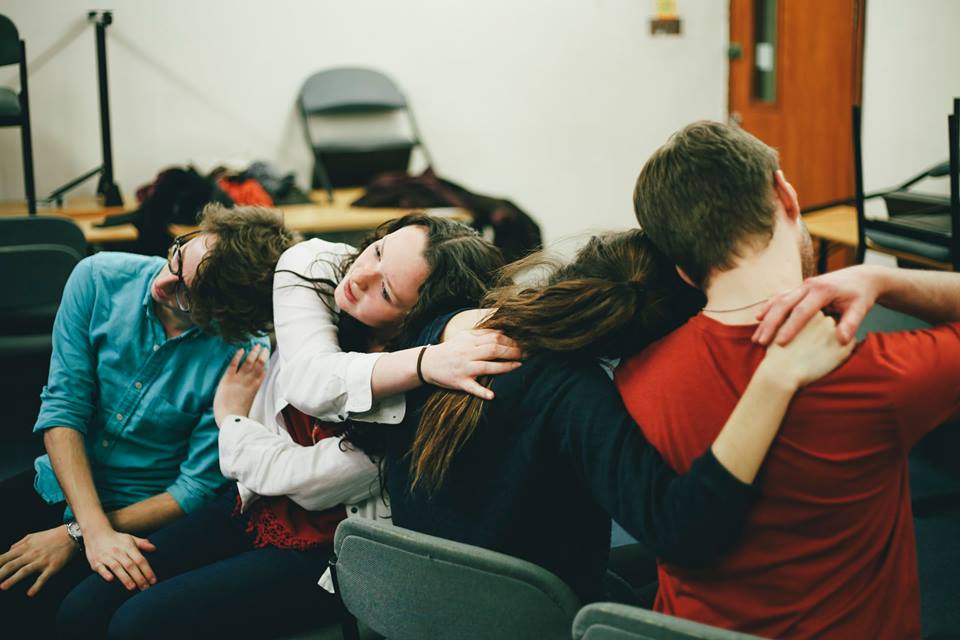
Rachel: Playing it as far as we could, stretching it as far as we could, allowing the characters to feel completely comfortable on stage with the short time that we had.
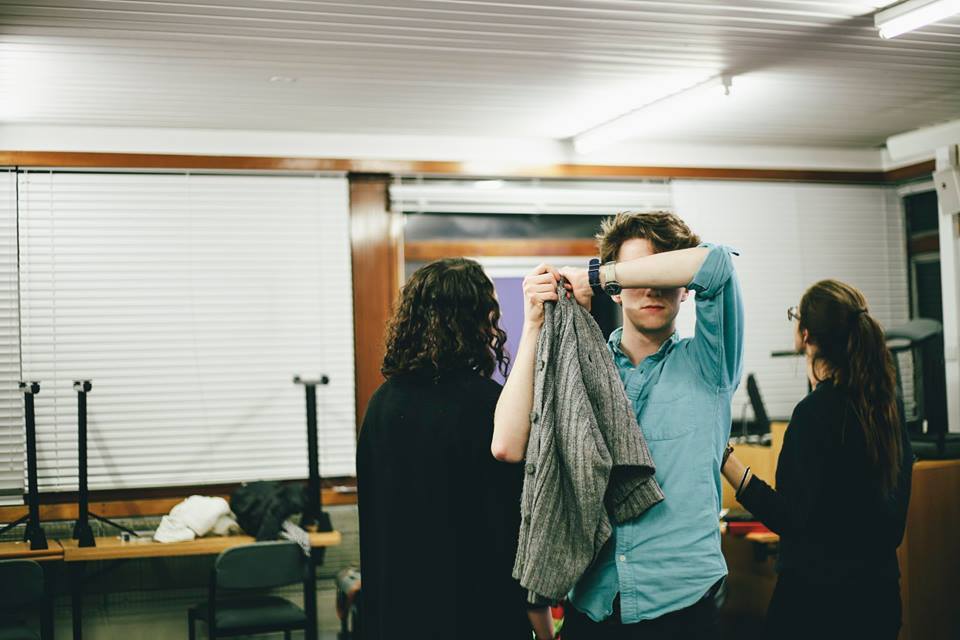
In terms of the props, I said from the beginning it will be minimal and it would be things that we are comfortable working with. So, occasionally I would go “let’s try this” and it just won’t work, so we would scrap it straight away. If the actor is not comfortable with it, it’s not necessary.
Grace: The props we were using also provided moments of connection, different characters using them.
Rachel: Again, it’s the idea of having on stage only visual things that need to be there, because the story is the important bit. You know, it’s not there to say “look at millions of pounds we can throw on this”, in fact I think our budget for props was like 10 pounds. In terms of managing it, we had diagrams of where every single thing went in each scene.
I think it’s rather challenging to create a performance in the space that you had to work with – Teviot Study, just a giant, empty two-story room rather than an actual stage. I thought the long silence at the beginning, when Sally just sits still for a few minutes worked very well to establish the room as a performance space.
Rachel: Sally is a character, but those moments when Sally sat on stage on her own, she could be anybody. And that was something we wanted to play up.
As for the story of how Tissue came about: I only do theater if there is a reason for it. I wouldn’t want to direct for the sake of just doing a show. I woke up at two in the morning with the idea of putting on “Tissue”, realizing that Bedlam hasn’t really done a charity show, not in a long time. And I wanted to direct such a show. So I put the two and two together. I’ve been part of an A-level course where “Tissue” was taught. So I went to Bedlam, proposed it, got it and then they went “we are in the round, by the way”. So I thought “huh, right, that just got a whole lot harder”. And actually, it ended up being so much better for it.
Grace: I can not imagine it not being in the round. There is that sense that when you are in the round you can’t escape, you are locked into it.
Rachel: Exactly. But that also makes it so difficult to find somewhere to do it in. This time, it was in the middle of the science festival so all the performance spaces in the city were taken. So we came to Teviot Study, and Jack Simpson, who is our tech guy went “yeah, we could do it in here”. I thought we could do this and just keep it really simple. Our techies did a stellar job with lighting, getting everything in, getting it rigged and looking good. It’s in the round, but I almost feel like having it in this space where people don’t feel like they are in a theatre, sitting on flipped down sits, it just makes it a bit more human again. That makes
it more intimate, rather than stating “you are watching art!” So, it was difficult, definitely. You know, in terms of finding the space, and finding the tech and working with the space that we have. But once we started performing in it we knew it was working. You just get this feeling of the space; that it works. The guys were happy in it, so I was happy with it.
 This play is special in that it brings people into the theatre who don’t usually go to theatre (say they are connected to cancer, but might not usually go to theatre) or people who always come to the theatre, to get them to see something in a new light and for them to walk away and perhaps just think about something in a slightly different way. With this show, maybe even go as far as to check themselves, to understand a bit more or to just break down this barriers of people not talking about things that need to be spoken about. I think for me that’s the most important thing about this project.
All the photos are taken from Cancer Out Loud Facebook page. If you get a chance to, go see Tissue at the Fringe.
 Theatre Machine